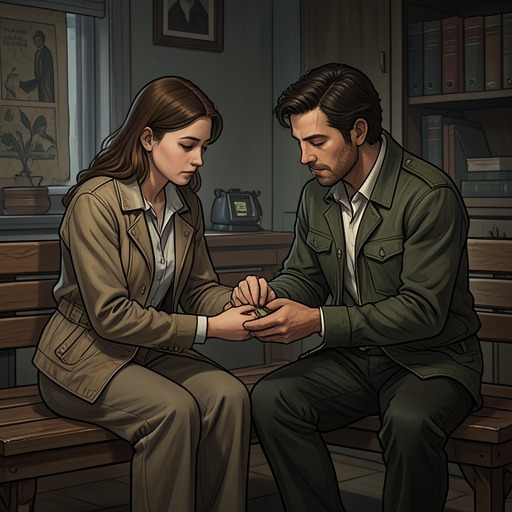
Sofia invites Juan to dinner and becomes his lover
Hot MilkSofia Papastergiadis’s invitation to Juan turns a day shaped by danger, theft, and unreturned longing into a new romantic attachment. The episode moves from the injury hut to the kitchen and terrace of Sofia’s temporary seaside home, where a stolen dorado becomes both supper and the occasion for her to act boldly. Her relationship with Juan begins not in a conventional courtship but through an invitation that redirects desire without resolving what she feels for Ingrid.
Setting and Preparation
The encounter develops against the unsettled conditions of the local beach. Earlier, Sofia had gone to a deserted stretch opposite a cement factory, where a café waiter warned her not to swim: three people had been badly stung that morning. The view joined the sea to industrial construction, with a desalination plant, a cargo ship, and unfinished hotels and apartments cut into the mountains. The beach was not an untouched refuge; it was a working, changing place where swimming carried risks. Sofia’s attention to water also has a private history. She habitually thinks about how to make water more suitable for her mother, weighing sparkling against still. That practical care sits alongside her own exposure to the sea and its stings. The episode’s movement toward Juan therefore begins in a setting where water is at once an everyday concern, a danger, and part of the landscape Sofia is trying to inhabit. Before the invitation, Sofia has stolen a dorado from a shop. She distracts the cashier by touching the price tag on langoustines while taking the fish, then walks out without stopping. She describes the act as concentrating her attention and giving her a new sense of purpose, though she questions what that purpose costs her. At home she cleans and prepares the fish, thinking across her Greek and Yorkshire family histories: one associated with catching fish in the shallows of the Aegean, the other with buying it from dockside trawlermen. The meal Juan will share is thus already bound to Sofia’s effort, risk, and divided inheritance.
The Invitation at the Injury Hut
After turning off the heat beneath the fish, Sofia walks across the beach to the injury hut. She recognizes her own growing boldness and asks the student there to join her for supper. He is surprised, then pleased, and introduces himself as Juan. Sofia answers by asking for the kind of information recorded on the hut’s forms—his date of birth, country of origin, and occupation—turning the formal language of an intake into a teasing response to his introduction. Juan is still completing the day’s paperwork, which records fourteen stings, but says he can come in twenty minutes. In the same conversation he tells Sofia that Pablo’s dog has disappeared after running into the sea in a panic. The dog’s fate is unknown, and Juan jokes that, if it is alive, the hut may have to deal with a bite fiercer than a jellyfish sting. His work brings him into contact with the immediate hazards of the beach; the invitation draws that practical acquaintance into Sofia’s private space. The exchange also carries a note of confrontation. Pablo has reportedly accused Sofia of threatening him. She responds that the threat involved the blood of the fish Juan is about to eat with her. The joke connects her meal to the accusation without concealing that the fish is stolen. The dinner is not a neutral gesture: Sofia has taken possession of something and now makes that act the basis of an invitation.
Dinner and a Change in Desire
When Juan arrives, he brings four bottles of beer he has kept in the injury-hut fridge and asks after Sofia’s mother. Sofia says that her mother is asleep and, for once, has not drawn the curtains to hide from the stars. The exchange places the evening within Sofia’s caregiving life, but gives her a brief setting apart from it: the terrace is laid for two, and Juan joins her there. They eat the dorado opposite one another. Juan explains that its flesh is succulent because of the layer of fat between skin and flesh. The fish Sofia had stolen, cleaned, and cooked becomes a shared meal rather than merely the object of her solitary decision. Afterward, their intimacy develops, and they become lovers. The change is expressed as a bodily and relational turn: Sofia, who has been rejected by Ingrid, approaches Juan as someone capable of being desired, while withholding that rejection from what she communicates through her gaze. That contrast is central to the episode. Sofia’s connection with Juan does not follow from a declared resolution about Ingrid; the account makes clear that the earlier longing remains part of the situation. Instead, Sofia acts while carrying that disappointment with her. Her own description of being bold and of having been stung into desire presents the new relationship as an opening created through action, not as proof that the previous attachment has disappeared.
Significance and Later Context
The episode brings together motifs that recur beyond the dinner: water, bodily vulnerability, care, and the difficulty of knowing what is safe. In a later conversation, Sofia hears of a gasoline spill near the local beach. Sea police order swimmers out; Ingmar disputes their tests, drinks water at their instruction, and then admits the spill is real. That later account is not a consequence of Sofia and Juan’s encounter, but it echoes the episode’s uncertain setting, where the sea can invite intimacy while also requiring warnings and checks. Juan’s place in the scene is specific: he is the student at the injury hut, occupied with forms and beach emergencies, before becoming Sofia’s dinner guest and lover. For Sofia, the invitation is a small but decisive exercise of initiative. She takes the fish, prepares the meal, and asks him to come; the evening shifts her from the hurt of unreturned desire toward a new intimacy, without promising that one attachment has settled the other.